Precipitation in Tropical Glaciers and Climate Modeling
The tropical glaciers of the Peruvian Andes serve as critical water reservoirs for millions of people and unique high-altitude ecosystems. However, these cryospheric regions are exceptionally sensitive to rising temperatures. Our recent work has quantified the precarious state of solid precipitation in this region. We estimate that a 2°C increase in global temperature could drastically reduce solid precipitation in the Andes to less than 10% of current levels. This shift from snow to rain accelerates glacier retreat by reducing the accumulation needed to offset melting, threatening the long-term hydrological security of the region.
In the high Andes of Peru, a seemingly simple experiment at Chalon Sombrero peak sought to reverse glacial retreat by manually painting dark rocks white. The premise was grounded in elementary physics: increase surface reflectivity, or albedo, to reduce heat absorption and encourage "cold to generate cold." While the Peruvian project focused on micro-climate restoration, it prompts a compelling planetary question: could such "whitewashing" interventions, if scaled to mountain ranges globally, effectively counter rising mean surface temperatures?
To explore the theoretical limits of this approach, we employed the Community Earth System Model (CESM2.1), simulating a radical geoengineering scenario over a twelve-year period (2000–2012). By engineering a synthetic soil type with a fixed, high albedo of 0.8, we effectively "painted" all global land surfaces situated above 1 kilometer in elevation. This modification allowed us to observe the potential climatic feedbacks of a coordinated, high-altitude albedo enhancement without altering other biophysical properties of the land cover.
The simulation yielded a distinct global signal, suggesting that the "positive feedback" observed in Peru can indeed translate to the planetary scale. The intervention drove a persistent yearly mean cooling of approximately 0.5°C, accompanied by a measurable expansion of snowpack in the treated regions. The mechanics followed the hypothesized pathway: the artificially brightened surfaces reflected a greater portion of incoming solar radiation, cooling the surface air and promoting snow retention. This, in turn, reinforced the albedo effect, creating a self-sustaining cycle of cooling in the most responsive regions.
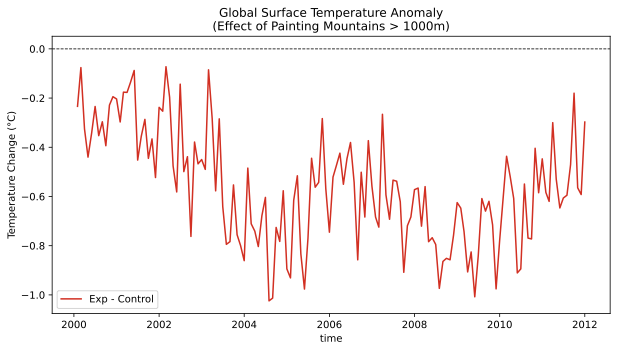 Figure 1: Time-series analysis of global mean surface temperature showing a persistent cooling anomaly of approximately 0.5°C relative to the control run (2000–2012).
However, the efficacy of this "whitewashing" was not spatially uniform. While mid-latitude ranges like the Himalayas and the Rocky Mountains exhibited significant snow depth increases, tropical high-altitude regions showed negligible change despite the intervention. This disparity highlights the complex interplay between altitude, latitude, and local atmospheric dynamics; simply increasing reflectivity is less effective in regions where atmospheric conditions do not favor snow persistence.
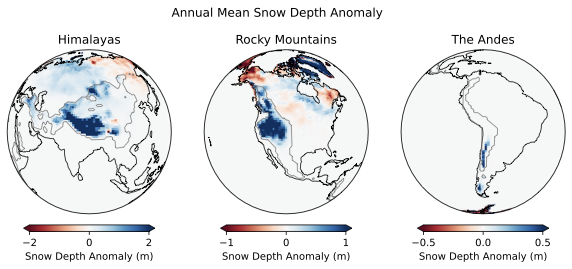 Figure 2: Spatial distribution of snow depth anomalies. Note the significant accumulation in mid-latitude mountain ranges (Himalayas, Rockies) contrasted with minimal impact in tropical highlands.
These findings suggest that while surface albedo modification holds promise as a geoengineering tool, a "blanket" approach may not be optimal. The results point toward the need for more targeted strategies, such as testing higher altitude thresholds (e.g., above 3 kilometers) to isolate regions where the cooling potential is maximized. Furthermore, running larger ensemble simulations will be crucial to distinguish this forced cooling signal from the noise of internal climate variability, helping to determine the precise efficacy of painting the world's mountains white.